Another Important Step in Aerospace Engine Technologies
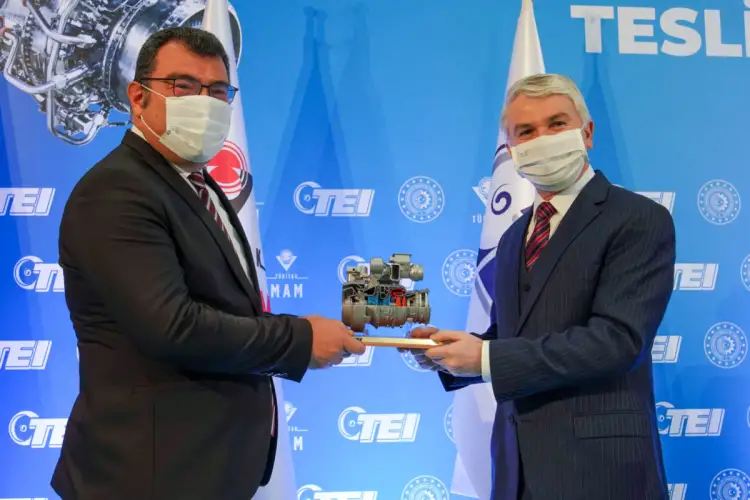
The "single crystalline blade casting" operations, which are considered a critical technology stage in turbine engines, were initiated in 2016 in cooperation with TEI and TÜBİTAK MAM with the KRİSTAL Project that was supported by the R&D and Technology Management Department of the Secretariat of Defence Industries . In light of the knowledge and experience acquired within the scope of this project, the production of cooled and uncooled turbine blades to be used in the high pressure turbine of Turkey's first national helicopter engine TEI-TS1400 was completed and delivered to TEI. Turkey's first national helicopter engine which has turbine blades designed, developed, manufactured and operated by TEI – TUSAŞ Engine Industries Inc., which is Turkey's leading company in aerospace engines, will be used on the TEI-TS1400's engine TS5.
Turbine blades are manufactured of nickel-based super alloy with a single crystalline precision casting method since they are one of the most critical parts of aerospace engines due to high temperatures, versatile forces and requirements to maintain parts and engine integrity under harsh environmental conditions. These parts are suitable for operation at a temperature of up to 1400°C with their highly precise cooling channel designs and thanks to single crystalline castings, subsequent heat treatments and simultaneous development of non-destructive control methods, another important step has been taken.
The only crystalline cast blades manufactured by TÜBİTAK MAM in high quality standards will first be used in ground tests of the TEI-TS1400 engine, and later in the project they will be used in certification processes that are very critical for aviation and then they will be used in the final engine.
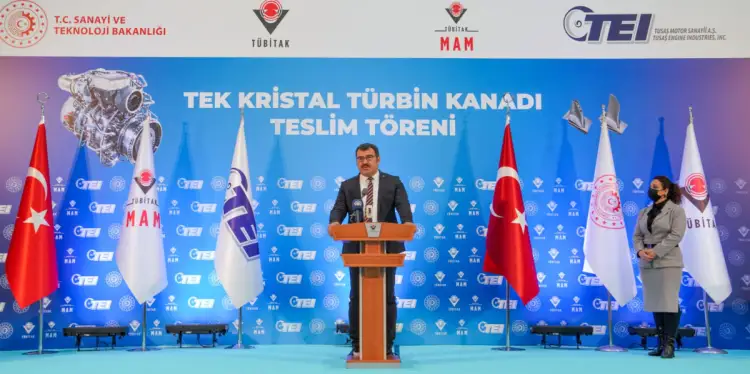
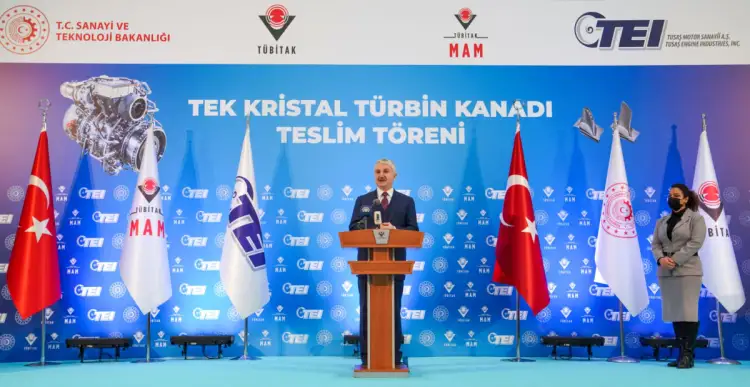
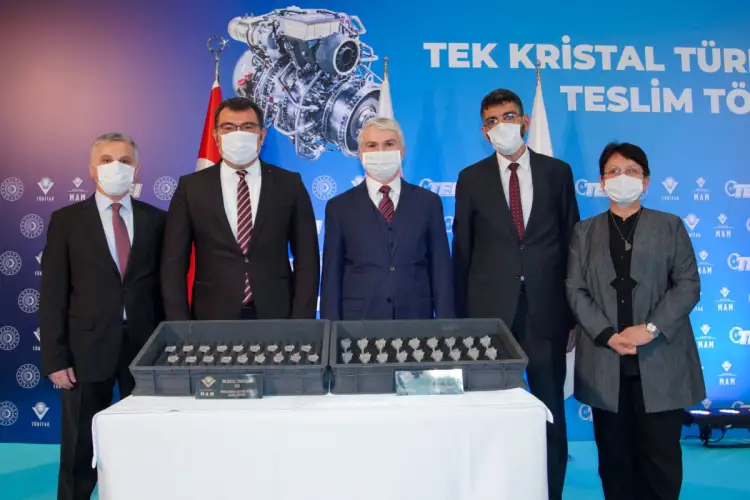
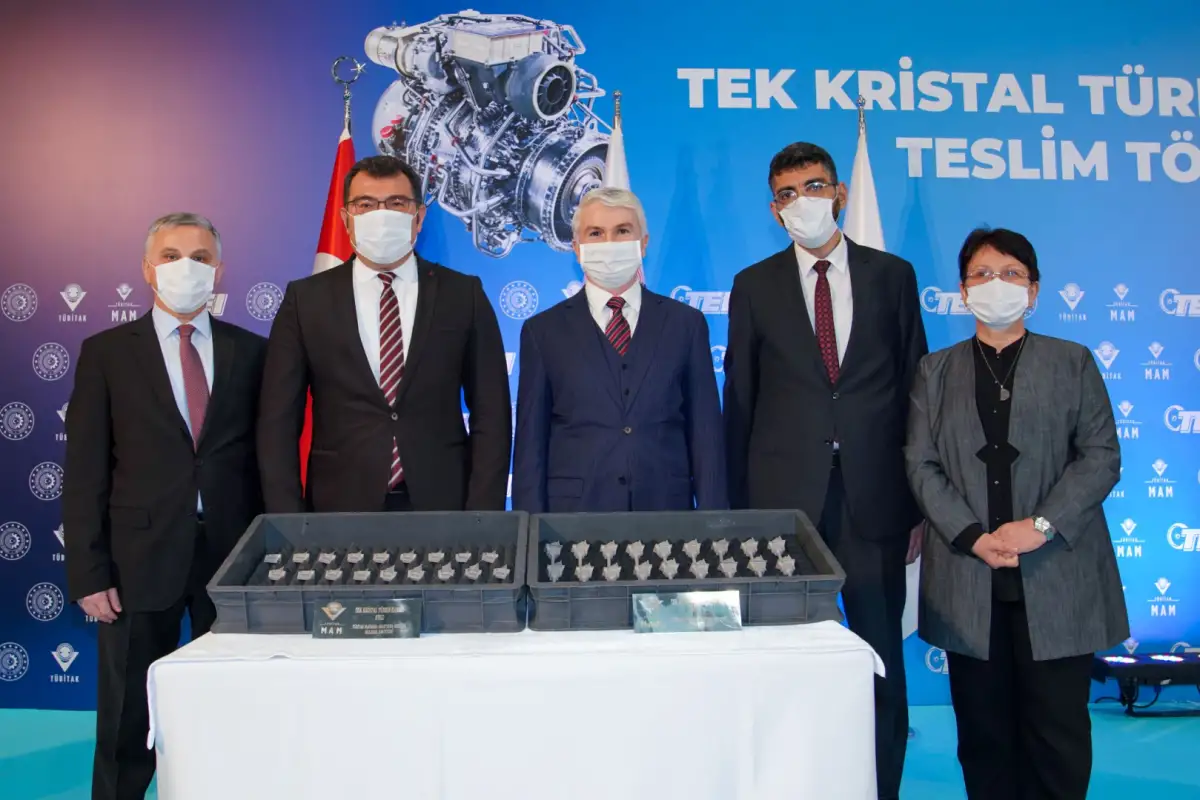
TÜBİTAK President Prof. Hasan Mandal, TEI Chairman and CEO Prof. Mahmut F. Akşit, TÜBİTAK MAM President Dr. Osman Okur, Materials Institute Director Prof. Metin Usta, Chief Expert Engineer Associate Prof. Havva Kazdal Zeytin, as well as the managers and employees of TEI and TÜBİTAK MAM project teams attended the delivery ceremony held at TÜBİTAK Gebze Campus.
Prof. Mandal, in his speech at the ceremony, stated that as a result of the cooperation of TÜBİTAK MAM and TEI, the only crystalline turbine blades which are among the most critical technologies of aviation engines were successfully produced.
Mandal emphasized that both the cooled and the uncooled system include a learning process which covers from its design to its production and said that "I also think that the competence and capability that we have gained here, and the material technologies are of importance in terms of the development and sustainability of our country, especially in the defense industry."
Mandal stated that they developed turbine blades with TEI, which work under difficult conditions and are sometimes not possible to import, and that they made the delivery of the first set and he emphasized the following:
"This is indeed an important achievement for our country. There was an issue which has been always said about the domestic and national production: 'Yes, you have a helicopter, but is the engine of this domestic?' Yes, TEI can produce it in a domestic way. Yes, there is an engine, but can the components inside the engine be produced domestic and national? Yes, we can now produce turbine blades as TÜBİTAK MAM, which is the most difficult component of our country's first domestic and national turboshaft engine. This technology is very critical and a very limited number of countries around the world have this technology. It's a very complex and difficult design, it's not easy to do. We've made it happen. Of course, this is not an ending process. Certainly, there's more to it. TÜBİTAK Materials Institute and TEI will now be able to produce nickel-based superalloys for these and similar applications starting from raw materials with the Aviation Engine Materials Development - Cevher Project which was signed yesterday."
TEI Chairman and CEO Prof. Mahmut F. Akşit shared that he was also a Member of the Board of Directors of EÜAŞ when he was a faculty member at Sabancı University and said that they made similar attempts for the blades which were needed by industrial gas turbines at that time and thus brought the infrastructure to TÜBİTAK MAM.
Akşit stated that they decided to develop blade technology here because they know the infrastructure owned by TÜBİTAK MAM, noting that even if they sell the turbine blade itself, which is one of the most important parts of aviation engines, they do not share its technology, how it is produced and similar points.
Emphasizing that although the blade used in aircraft engines is smaller, it is a process with higher technology and more difficulty, Akşit said, "Fortunately, our friends at TÜBİTAK MAM Materials Institute managed this proudly and gave us the blade technology that we needed."
Akşit said that the received blades were not the first turbine blades produced by TÜBİTAK, but that these blades were used in the TEI-TS1400 engine they had previously delivered to TUSAŞ, however they were not able to have a ceremony at that time.
Stating that they received previous turbine blades gradually as they were completed, Akşit stated: "What you see here is a full set for an engine. Both the first-stage single crystalline, an inside-cooled blade, which is harder and a second-stage single crystalline, but with no inside cooling blades. We aim to use this in our TS5 engine. Previously, these blades were used in the engines which we delivered to Turkish Aerospace. This is the full set of our TS5 engine. For the first time, we had the opportunity to see it together as a full set."
Akşit stated that they produced the TS4 engine and that their testing process is in progress, "We delivered our first national helicopter engine TEI-TS1400 on December 5th. Hopefully, these blades will be installed on our TEI-TS1400 engine TS5. I wish that they will work in the Gökbey helicopter."
Pointing out that the first stage blades come first when the most critical parts in an engine are listed, Akşit said, "Then maybe the combustion chamber can be mentioned, then the second stage blades are critical in terms of temperature and the difficulty of technology. The compressor side is also very difficult, but the most difficult one is the first stage single crystalline blades. These are the most critical parts. I'm not going to say you can't start the engine if you can't do that, but you can't generate power. You can't reach to high temperatures."
About the function of single crystalline turbine blades in engines, Akşit said:
"All jet engines work with the expansion of warm air like other fossil fuel engines. How do we warm up the air? We put the fuel in it and strike the match so that the air warms up and expands. And to make this happen, we need to take the air from the compressor and compress it. If we don't compress the air, the combustion event will be very slow and we'll get mush lower power than the same engine. The power we obtain in unit time decreases. Thus, we raise it to a high pressure. It will burn more efficiently, so we can get more out of the engine in unit time. So instead of using the gas that comes out of the back directly, we transform some of the energy into rotation by making it hit these hot blades; this absorbs the air in the compressor and supports the compression operation. Without these blades, the engine could not be operated. So these blades operate the compressor with significant power."
After the delivery which occurred following the speeches, the event ended after the guests visited the High Temperature Materials Research, Development and Repair Center of Excellence.